Stories from one of our neighborhood dining centers, where connection is always on the menu.
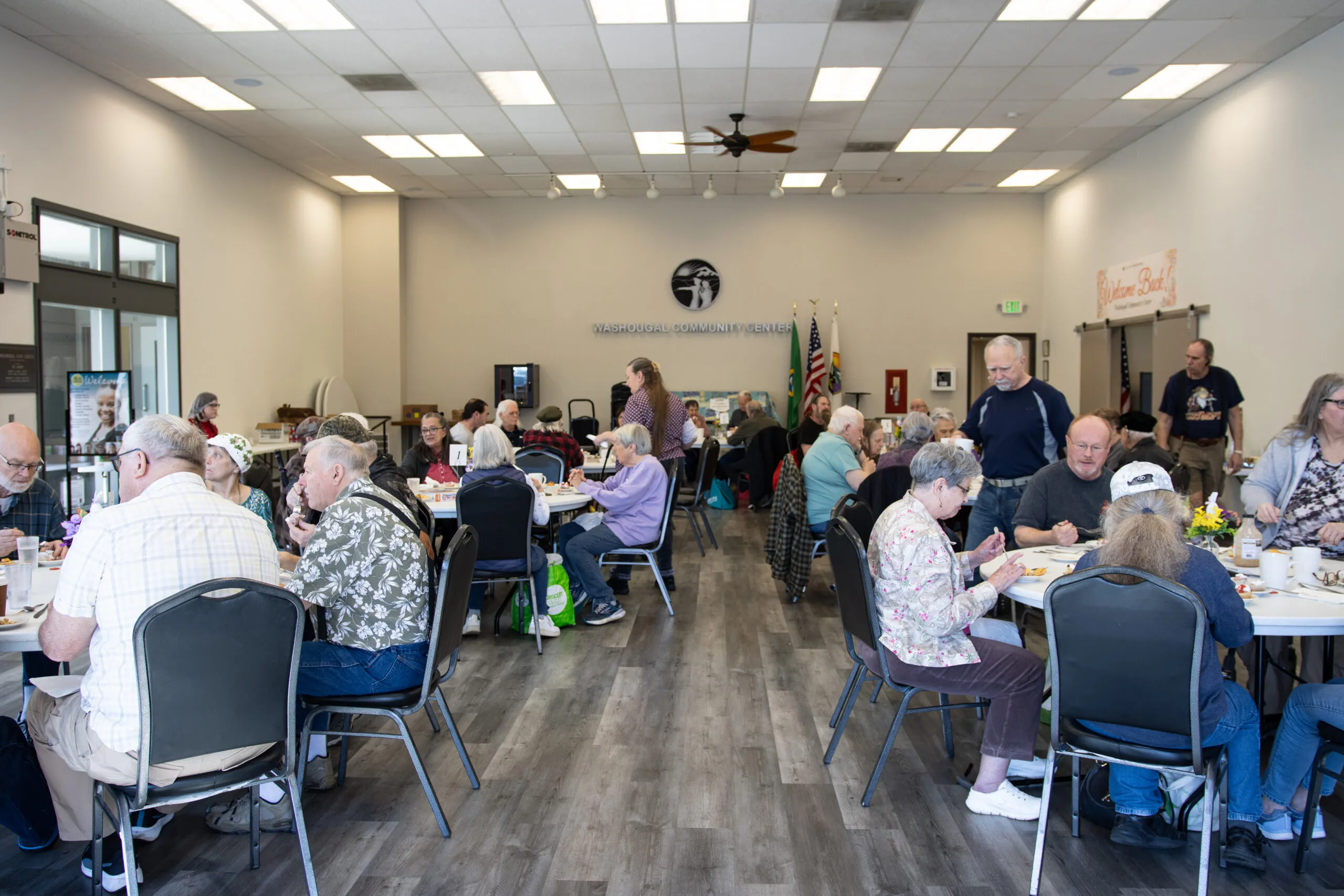
When the doors reopened at the MOWP Washougal Center after five months of renovations at the Washougal Senior Center, it didn’t take long for the space to fill with laughter, the clatter of serving spoons, and the smell of strawberry muffins and broccoli cheese soup. This isn’t just a place to get a nutritious lunch — it’s a place to be seen, to belong, and to feel part of something again.
Since 2006, Meals on Wheels People has been a lifeline for older adults in Clark County. In the past year alone, we’ve delivered more than 172,000 meals to nearly 1,800 individuals across the county — with the help of over 240 volunteers. But it’s never just about the meal. It’s about the people who show up, week after week, to prepare, deliver, and share those meals — and the people on the receiving end who say it’s the best part of their week.
The Washougal Center is one of several in-person dining centers in the region, where older adults gather to share meals, build friendships, and stay connected to their community. But behind the scenes, it’s also a vital hub of operations — where volunteers prepare, pack, and send out meals to hundreds of home-delivery participants across the area.
At the center, you’ll find all the ingredients that make Meals on Wheels People special: volunteers who treat meal prep like a game show challenge, longtime drivers checking in on participants like old friends, and participants who come not just for food but for connection.
These are their stories.
Volunteer Greeter Judy Jones

Judy Jones has always had a heart for helping others. At nearly 79 years old, she shows up at the Washougal Center with a quiet sense of purpose — welcoming folks with a smile, checking people in, and making everyone feel at ease.
Judy moved to Washougal after losing her husband and spending time alone in Longview. Her niece — her brother’s daughter — invited her to live with them. It wasn’t long before Judy’s niece gently nudged her to start getting out of the house more.
“She said, ‘You should go out and do things,’” Judy recalls. “My brother used to come here, so I started going to the senior center. That was about four years ago.”
When the Washougal Center closed temporarily for renovations, Judy didn’t skip a beat — she volunteered at the Luepke Center in Vancouver one day a week. But she never stopped thinking about coming back.
“I told them at Luepke, when Washougal opens again, I’m going home!” Now that she’s back, Judy is in her element. “I just like to help people,” she says. “Even if it’s just checking people in. Someone has to do it — and I enjoy it. It’s a place people can socialize, make new friends, and not feel like you’re being shut in all the time.”
Diners Bonnie & Kelley

Kelley, 78, didn’t plan on moving to Washougal. He came up from Arizona to surprise his son for a birthday visit — and never left.
“I was in Kingman, living by myself for five years, sitting in a room, watching TV, doing nothing,” he says. “My son said, ‘What are you doing down there? Why don’t you move up here?’”
Shortly after arriving, Kelley wandered into Washougal Center, and he’s been a regular ever since. “I wasn’t really eating good. When you live by yourself, you eat a lot of TV dinners,” he says. “Now, I get three good meals a week. And I get to socialize. That’s really important when you live by yourself. You kinda get suicidal, to be honest. You just give up. Here, you get revitalized.”
One of his neighbors noticed the difference. Bonnie, 79, lost her husband two years ago and had been keeping mostly to herself — until Kelley knocked on her door. “He said, ‘Do you like bingo?’ That’s how I got here,” she smiles. “I love it. Everybody’s friendly. I get to mingle with people. I don’t feel so lonely.”
Diner Donna

Donna spent her life surrounded by books and conversation. As a middle school librarian, she made her library a safe haven for students who needed someone to talk to.
“Kids that age need someone to talk to,” she says. “My library was full of kids.”
Now, at 89, Donna is still looking for connection — but in a different chapter of life. “My husband is gone. My friends are all gone. I’m lonely.”
Donna is honest about the toll isolation can take, but she lights up when talking about her time at the center. “I love this. It’s nice to come here and talk to people.” Whether she’s chatting at a lunch table or reminiscing about her years in the library, Donna brings the same spirit she once offered to her students — a reminder that we all need someone to talk to.
Kitchen Volunteers Sean & Beverly Pryor

Every Tuesday morning, Sean and Beverly Pryor drive down to the Washougal Center, ready to cook up whatever the freezer holds. For Sean, it’s not just cooking — it’s a creative challenge.
“It’s just like a game show,” he laughs. “I get here in the morning, and we have no idea what we’re going to serve. We open the refrigerator, open the freezer, we have a discussion that lasts about 2 minutes, and then we go crazy. It’s a lot of fun.”
Sean and Beverly started volunteering just before the pandemic, after hearing the center needed help in the kitchen. They’ve been showing up — and having fun — ever since.
“We really like to cook,” Beverly says. “But what I love most is the people — the camaraderie, the friendships that are formed.” They keep track of their Tuesday regulars. They swap stories. They laugh. And above all, they care. “Folks are lonely,” Beverly says. “Plus, we give them a meal. For Sean and I, it feels good.”
Volunteer Delivery Drivers George & Kathy Capacci

Every Wednesday, volunteers from the Rotary Club of Camas-Washougal head out from the Washougal Center to deliver meals — and connection — to older adults across the community. George and Kathy Capacci are part of that team.
“We’ve been doing this about five years,” George says. “But my first Meals on Wheels experience was with my dad in central New York.” George’s dad kept delivering into his late 80s, and the example stuck. Now, George and Kathy carry on the tradition together. “I do the paperwork,” Kathy says with a smile, while George loads up the car. Their route has changed over the years, but they’ve gotten to know the people on it — and they always take time to check in.
For George, the impact of these visits is clear. “Most of the folks don’t have a lot of interactions,” he says. “Some are pretty marginalized. They have mobility challenges. They have challenges getting to the store or getting a balanced meal. This is a small commitment of time, but it’s very rewarding,” he says.
Back at the center, more meals are being packed for delivery. But for George and Kathy, this isn’t just a drop-off. It’s a reminder that a simple meal can make someone feel remembered, seen, and cared for.
Home-delivery Meal Recipient Charles

Charles has been receiving meals for less than a year — but it didn’t take long for him to understand how essential they are.
“I got sick,” he says. “My brother had to come down and help me. He’s the one who got me signed up.”
At the time, Charles could barely stand. His blood pressure medication wasn’t working, and fainting spells left him unable to cook or even leave the house. He stopped driving. His money ran out. His cat meowed for food he couldn’t afford. Stress mounted.
“As it is right now, I have a $1.60.” That’s when Meals on Wheels People stepped in — and everything started to shift. “Ever since I had it, I absolutely love it. I get to visit with someone, and the food is so integral to my life. There are a great lot of people who don’t even know they need this, and once they get it, they go, ‘Oh, my life is so much easier now.’”
For Charles, it’s more than easier. It’s possible.
Home-delivery Meal Recipient Peggy

If you walk by Peggy’s home in Washougal, you’ll spot a mailbox that reads “Grandma’s Garden.” Inside, you’ll find someone who’s spent a lifetime preparing for the season she’s in now.
“We built this house in 2000,” she says. “It’s completely handicap accessible. We knew someday we would need it.” Wide hallways. A ramp in the garage. A walk-in shower. Everything designed with care and foresight — just like Peggy’s life. She’s lived in the neighborhood for 25 years and raised seven children — six of them girls. One daughter became a medical assistant just so she could help care for Peggy and her husband as they aged. But even with strong family support, food security can be a challenge. “I live off my husband’s Social Security. So this is just wonderful. It helps those dollars stretch.”
Peggy also has to manage her vitamin K intake. The meals help her stay on track — nutritious, balanced, and timed right for her health needs. “I get my veggies,” she says. Meals on Wheels People helps Peggy continue to live safely and independently in the home she loves — surrounded by flowers, family, and memories.
Home-delivery Meal Recipient Job

Job grew up on Southern cooking. His mother made everything from scratch, and the table was always filled with warmth and nourishment. But after losing his sight, the food he loved — and the comfort it brought — became harder to access.
“Once I lost my sight, I could no longer cook,” he says. “Eating out was fine, but it wasn’t health conducive.”
During a conversation with his health care provider, Meals on Wheels People came up. “I figured, I’ll give it a try,” he recalls. That was over a year ago. Since then, the meals have kept Job nourished and the visit at the door keeps him connected. And the memory of his mother’s kitchen? That stays with him — carried now in flavors that feel a little closer to home. “I can’t get enough of the shepherd’s pie.”
A Place to Come Home To
At every Meals on Wheels People center, no one is just a number on a delivery route or a name on a sign-in sheet. Everyone who walks through the doors — whether to eat, volunteer, prep meals, or check in on a neighbor — becomes part of something bigger. It’s not just about what’s on the plate. It’s about being seen. Being remembered. Being connected. In a world where it’s easy to feel invisible, Meals on Wheels People reminds us all that we still belong — and that there’s always a seat at the table.